The Seven Coloured Earths, a small region near the village of
Chamarel, Mauritius, is a geological curiosity and a major tourist
attraction of Mauritius. This relatively small area of about 7,500
square meters comprises of sand dunes of seven distinct colours
(approximately red, brown, violet, green, blue, purple and yellow).
The sands were formed from the decomposition of volcanic rock (basalt) gullies into clay, further transformed into ferralitic soil by total hydrolysis (chemical break- down of minerals by water). The two main elements of the resulting soil, iron and aluminium, are responsible for red/anthracite and blue/purplish colours respectively. The different shades of colour are believed to be a consequence of the molten volcanic rock cooling down at different external temperatures.
An unusual property of the sands is that they settle in different layers even if mixed together that gives the dunes a surrealistic, striped colouring. This strange phenomenon can be observed even on a smaller scale, if one takes a handful of sands of different colours and mixes them together, they'll eventually separate into a layered spectrum. The cause of their consistent spontaneous separation is yet to be explained. Another interesting feature of Chamarel's Coloured Earths is that the dunes seemingly never erode, in spite of Mauritius' torrential, tropical rains.

Photo credit
 The place has become one of Mauritius' main tourist attractions since
the 1960s. Previously, visitors wee allowed to walk between the sand
dunes when visiting the park. Nowadays, the dunes are protected by a
wooden fence and visitors are not allowed to climb on them, although
they can look at the scenery from observation outposts placed along the
fence. Curio shops in the area sell small test-tubes filled up with the
coloured earths.
The place has become one of Mauritius' main tourist attractions since
the 1960s. Previously, visitors wee allowed to walk between the sand
dunes when visiting the park. Nowadays, the dunes are protected by a
wooden fence and visitors are not allowed to climb on them, although
they can look at the scenery from observation outposts placed along the
fence. Curio shops in the area sell small test-tubes filled up with the
coloured earths.
 Photo credit
 Photo credit
 Photo credit

 Photo credit
 Photo credit
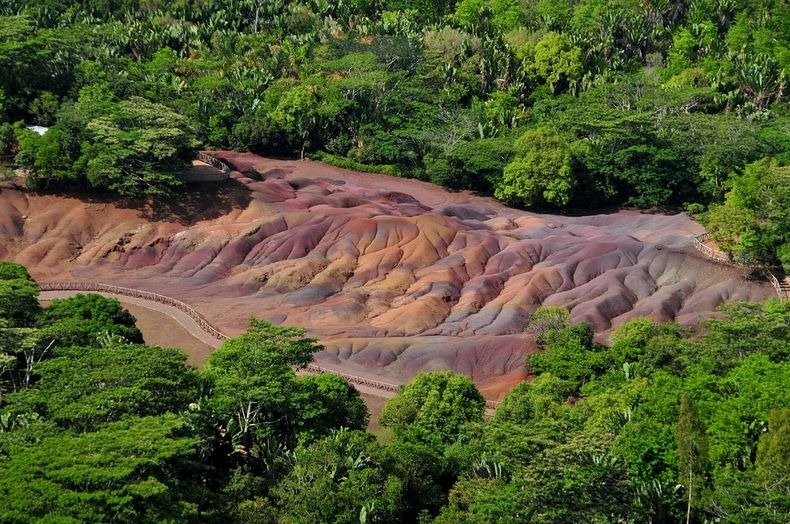 Photo credit
 Photo credit

Source
Reade more >>
The sands were formed from the decomposition of volcanic rock (basalt) gullies into clay, further transformed into ferralitic soil by total hydrolysis (chemical break- down of minerals by water). The two main elements of the resulting soil, iron and aluminium, are responsible for red/anthracite and blue/purplish colours respectively. The different shades of colour are believed to be a consequence of the molten volcanic rock cooling down at different external temperatures.
An unusual property of the sands is that they settle in different layers even if mixed together that gives the dunes a surrealistic, striped colouring. This strange phenomenon can be observed even on a smaller scale, if one takes a handful of sands of different colours and mixes them together, they'll eventually separate into a layered spectrum. The cause of their consistent spontaneous separation is yet to be explained. Another interesting feature of Chamarel's Coloured Earths is that the dunes seemingly never erode, in spite of Mauritius' torrential, tropical rains.
Photo credit
The place has become one of Mauritius' main tourist attractions since
the 1960s. Previously, visitors wee allowed to walk between the sand
dunes when visiting the park. Nowadays, the dunes are protected by a
wooden fence and visitors are not allowed to climb on them, although
they can look at the scenery from observation outposts placed along the
fence. Curio shops in the area sell small test-tubes filled up with the
coloured earths.
Source